Seth Klarman's latest portfolio update contains two very different stories. One is about change: a near-doubling of Axalta, two new names, and substantial reductions in Alphabet and Union Pacific. The other is about patience: Baupost ended the quarter with exactly the same number of Amazon, Elevance Health and Restaurant Brands shares as three months earlier.
Those three unchanged positions account for 37.83% of the disclosed portfolio. The loudest trade is not necessarily the most important investment.
The more revealing question is how the smaller moves fit around that stable core. A newly independent aerospace business, a coatings merger and a cluster of distributors suggest several distinct opportunities, rather than one sweeping call on the market.
This deep dive compares Baupost's September 30, 2026 holdings with its June 30 filing. The new 13F was filed on November 13. These are quarter-end snapshots, not trades made on the day the update appeared on InvestCroc.
What changed in Seth Klarman's Q3 2026 portfolio?
Baupost reported 21 positions, down from 23. Matching securities across the two filings produces two new positions, six increases, four reductions, nine unchanged positions and four names no longer reported.
| Position | Shares at June 30 | Shares at September 30 | Change in shares | Q3 weight |
|---|---|---|---|---|
| Honeywell Aerospace | — | 1,132,000 | New | 3.48% |
| SiteOne Landscape Supply | — | 1,245,000 | New | 2.23% |
| Axalta | 1,274,356 | 2,506,031 | +96.65% | 1.60% |
| Herbalife | 9,259,844 | 10,259,844 | +10.80% | 2.47% |
| CME Group | 619,000 | 685,435 | +10.73% | 3.56% |
| Genuine Parts | 2,816,178 | 3,097,978 | +10.01% | 7.72% |
| Wesco | 662,881 | 718,523 | +8.39% | 5.12% |
| Ferguson | 1,450,594 | 1,571,594 | +8.34% | 6.93% |
| Aon | 687,000 | 674,779 | −1.78% | 3.70% |
| Molina Healthcare | 633,609 | 449,609 | −29.04% | 1.68% |
| Alphabet, Class C | 1,371,931 | 949,931 | −30.76% | 6.41% |
| Union Pacific | 1,185,395 | 795,395 | −32.90% | 4.29% |
Weights are percentages of the securities disclosed in this 13F, not percentages of Baupost's total assets. “New” means absent from the previous filing; changes are net differences between snapshots.
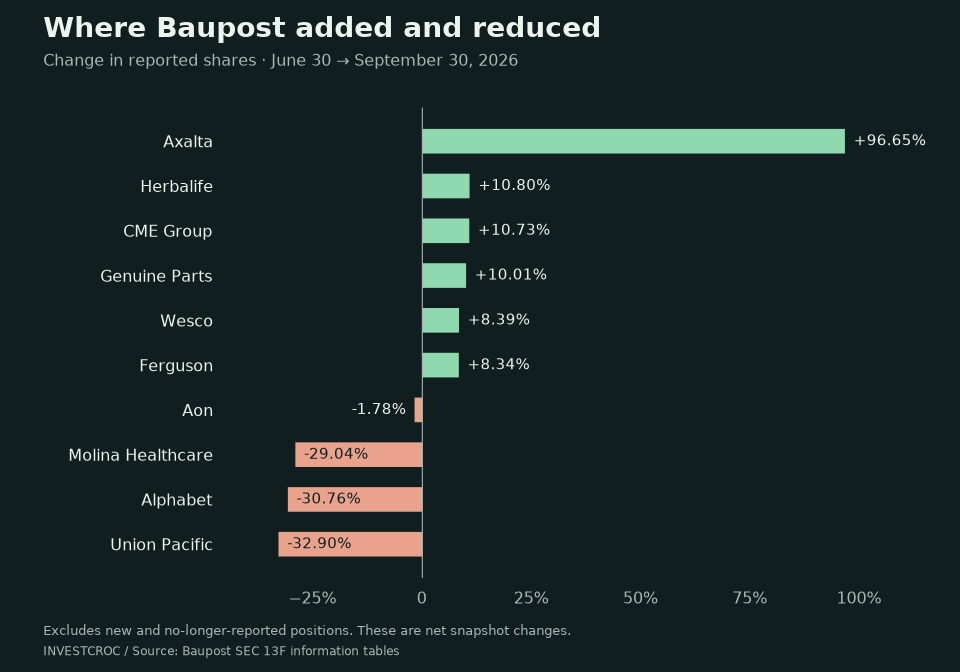
Axalta nearly doubled. Position size tells the other half of the story
Baupost added a net 1,231,675 Axalta shares, increasing the reported position by 96.65%. That is the quarter's largest percentage increase among continuing positions. Yet Axalta still represents only 1.60% of the disclosed portfolio.
Both numbers matter. The increase is substantial relative to Baupost's starting position; the resulting allocation is modest relative to the whole book. Describing it simply as a massive bet would erase that distinction.
There is also a concrete corporate event behind the company. Axalta's Q3 SEC report describes its proposed all-stock combination with AkzoNobel, originally agreed in November 2025. Shareholders approved the transaction on August 5, 2026, during the quarter covered by Baupost's filing. Under the agreement, each Axalta share would convert into 0.6539 AkzoNobel shares, subject to closing.
That makes Axalta worth studying through two lenses: the underlying coatings business and the economics of a pending transaction. The filing does not tell us which matters more to Baupost, or whether it hedged any exposure elsewhere.
The distinction is practical. An all-stock deal does not promise a fixed cash payout. The value ultimately received depends on the acquirer's share price, while delays, required disposals and failure to complete can change the outcome. A position can look attractive on a standalone basis, on expected combined-company earnings, or because of the exchange ratio. Those are different theses.
What changed after quarter-end? The European Commission gave conditional approval on November 6, with a remedy involving AkzoNobel's European vehicle-refinish business. A November 11 update said UK competition concerns remained under review and the companies still expected completion in early 2027. These developments inform today's analysis; they cannot be presented as information Baupost necessarily had when it increased the holding.
The quieter pattern: businesses that keep things working
Three additions are less dramatic individually but more interesting together. Baupost increased Genuine Parts by 10.01%, Ferguson by 8.34% and Wesco by 8.39%. Alongside the new SiteOne position, these four companies represent 22.00% of the disclosed portfolio.
They serve different markets, but all put distribution between a complicated supply base and customers who need products to complete a job.
| Company | What the business distributes | Question worth investigating |
|---|---|---|
| Genuine Parts | Automotive and industrial replacement parts | Does dependable availability support repeat business and attractive returns on inventory? |
| Ferguson | Plumbing, HVAC, water and related supplies | How much demand comes from necessary repairs versus new construction? |
| Wesco | Electrical, communications and utility products and services | Can infrastructure demand translate into cash after inventory and receivables? |
| SiteOne | Landscape supplies for professional customers | Can branch economics improve while underlying demand remains soft? |
These descriptions come from Genuine Parts, Ferguson, Wesco and SiteOne. The investment interpretation is ours.
Consider a contractor with a crew waiting for the right fitting. The fitting may be a small part of the project's cost, but a delay can be expensive. Stock availability, technical help and a convenient branch can therefore matter alongside price. That is a plausible source of economic value for a distributor.
The counterargument is equally important. A large branch network costs money even when demand slows. Inventory ties up cash. Acquisitions can disguise weak organic growth. And different customer bases create different cycles: automotive replacement parts, homebuilding and data-center infrastructure are not interchangeable exposures.
This is a useful research theme, not evidence that Baupost has declared all distributors cheap or recession-proof. The 13F supplies the shortlist. Margins, working capital, acquisition discipline and the price paid must supply the investment case.
SiteOne: an opening position in an imperfect operating environment
Baupost first reported 1,245,000 SiteOne shares, a 2.23% weight. The company supplies landscape professionals, making it a natural addition to the distribution theme—but its operating picture deserves scrutiny.
In results published October 28, SiteOne reported Q3 sales growth of 3%, while organic daily sales fell 1%. Gross margin increased by 80 basis points to 35.5%. It also announced a post-quarter increase of $500 million in its repurchase authorization and planned workforce reductions and branch consolidation or closures.
These post-quarter disclosures reveal a tension worth following: better margins alongside soft underlying demand. They do not establish Baupost's purchase rationale. A recovery case would require sustainable operating improvement; a weaker case would depend too heavily on acquisitions, pricing or cost reductions to offset volume pressure. A repurchase authorization also allows buybacks—it does not guarantee execution or an attractive purchase price.
Honeywell Aerospace: a new position after a major separation
Honeywell Aerospace is the larger of the two new positions: 1,132,000 shares, accounting for 3.48% of the disclosed book.
Honeywell completed the aerospace separation on June 29, 2026. Honeywell Aerospace began trading under HONA; shareholders of record received one aerospace share for every two parent shares held.
The timing matters. The separation happened before the June 30 comparison date, and neither Honeywell nor Honeywell Aerospace appears in Baupost's Q2 table. HONA then appears in Q3. It is therefore misleading to casually describe the position as shares automatically received from a parent holding visible in the prior filing. Equally, two quarterly snapshots cannot reconstruct the exact acquisition route or trading dates.
For investors studying spin-offs, the appeal is that a standalone business can become easier to analyze and value. Its own management incentives, capital allocation and financial statements become more visible. The risks deserve the same attention: standalone expenses, allocated debt and separation costs can offset the benefits of greater focus.
That is the research opportunity here. The filing establishes a meaningful new exposure to a recently separated company. It does not establish the valuation Baupost assigned to it.
Alphabet and Union Pacific were cut—not abandoned
Baupost reported 422,000 fewer Alphabet Class C shares and 390,000 fewer Union Pacific shares. Those are reductions of 30.76% and 32.90%, respectively. Even after the cuts, the positions account for 6.41% and 4.29% of the disclosed portfolio.
A reduction can reflect a changed business assessment, valuation discipline, risk limits or a better opportunity elsewhere. The filing cannot distinguish between them. It also cannot support a claim that Klarman has turned broadly bearish on technology: Amazon remained the largest disclosed holding, with its share count unchanged.
Healthcare offers a similar warning against sweeping interpretations. Molina's share count fell 29.04%, while Elevance's stayed at 1,275,154. The observable decision is selective, not a uniform reduction across the two insurers.
Four previous names no longer appear: Teleflex, Norwegian Cruise Line, Liberty Global Class C and DNOW. Together, they represented 8.71% of the Q2 disclosed portfolio. “No longer reported” is the precise description supported by these snapshots; the filings do not provide disposal dates, execution prices or a realized profit-and-loss account.
The strongest concentration signal came without additional shares
Amazon, Elevance and Restaurant Brands are the three largest Q3 holdings. Their combined weight increased from 34.62% to 37.83%, despite no change in their reported share counts.
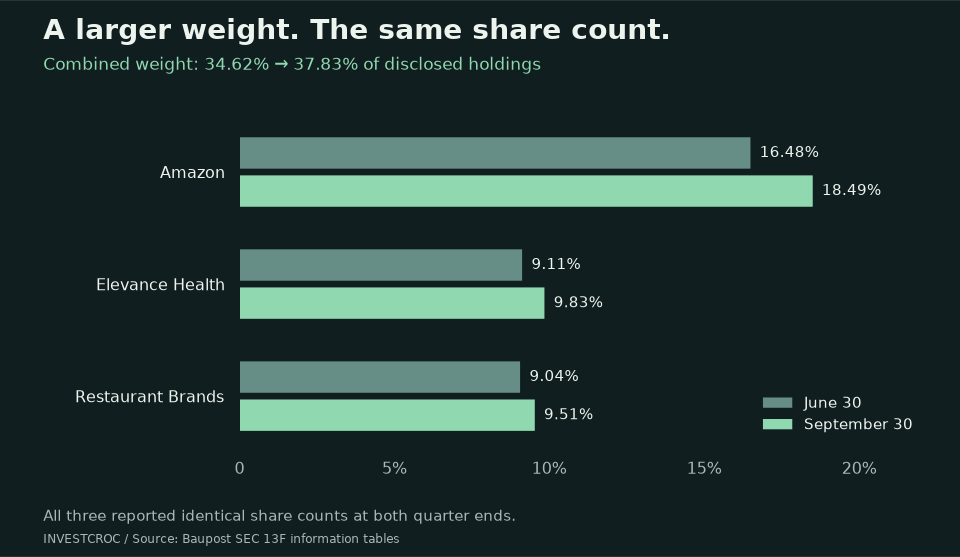
This is why a change in weight should not automatically be labeled buying or selling. A position can become a larger percentage because its price rises, because other holdings fall, or because the denominator shrinks as positions are removed.
Axalta's near-doubling is a striking transaction signal. The unchanged core is the more important concentration signal. A reader who focuses entirely on new purchases could miss where most of the disclosed capital remains exposed.
What to watch next
The next filing will help test whether these were opening moves or finished adjustments. A larger SiteOne or Honeywell Aerospace position would show further accumulation; another sizeable reduction in Alphabet or Union Pacific would show that the trimming continued. Neither outcome, by itself, explains the investment rationale.
The business evidence should move alongside the portfolio evidence. For Axalta, follow remaining approvals and the economics of the proposed combination. For SiteOne, watch organic demand and whether margin gains survive. For the distributors, examine cash conversion as well as revenue growth. For Honeywell Aerospace, study the financial record emerging under independent ownership.
Our reading of the quarter is selective repositioning around a stable core. Baupost made room for new opportunities and increased several existing holdings, while leaving its three largest positions unchanged in shares. The useful lesson for a value investor is to connect the size of a move with the size of the resulting position—and then investigate the business before copying the trade.
Explore Seth Klarman's portfolio on InvestCroc to follow subsequent disclosures. For a related discussion of why owning an investment company and copying its reported holdings are different strategies, read our Berkshire Hathaway portfolio comparison.
Sources and calculation notes
The portfolio comparison uses Baupost's Q3 2026 information table and Q2 2026 information table, matched by security identifier. Percentage changes equal the change in reported shares divided by the June 30 share count. Portfolio weights equal each reported value divided by the sum of that quarter's reported values. Figures are rounded only for display.
We use shares and relative weights rather than dollar position sizes: the rendered SEC tables label values as dollars, while 13f.info presents the same aggregate numbers in thousands. A consistent unit multiplier leaves the weights unchanged. No portfolio return or cash-flow estimate is inferred from changes in the reported totals.
A 13F covers a defined set of reportable securities, not every asset or hedge a manager owns. It does not provide trade dates, cost bases or short positions; see the SEC's Form 13F guidance. Unchanged quarter-end shares do not prove there was no trading in between. Company developments are dated separately from the holdings snapshot. Business interpretations in this article are InvestCroc's analysis, not statements of Baupost's intent. Research cutoff: November 15, 2026.
Explore the source portfolio
Open the report quarter discussed in this article.
- Baupost Q3 2026: holdings and reported changes
- GPC: inspect the reported position history
- FERG: inspect the reported position history
- WCC: inspect the reported position history
- SITE: inspect the reported position history
- MOH: inspect the reported position history
- ELV: inspect the reported position history